Why Do Slate Sphere Water Features Sound So Good?
One of the first things people notice when they stand beside one of our slate sphere water features is the sound.
It’s not the sharp trickle you often hear from many fountains, and it isn’t the hollow splash that comes from polished stone or moulded features. Instead, it’s a softer, more natural sound — closer to water moving over rocks in a stream.
People often ask why.
The answer lies in the nature of the slate, and in the way the sphere itself is built.
The split surface of the slate
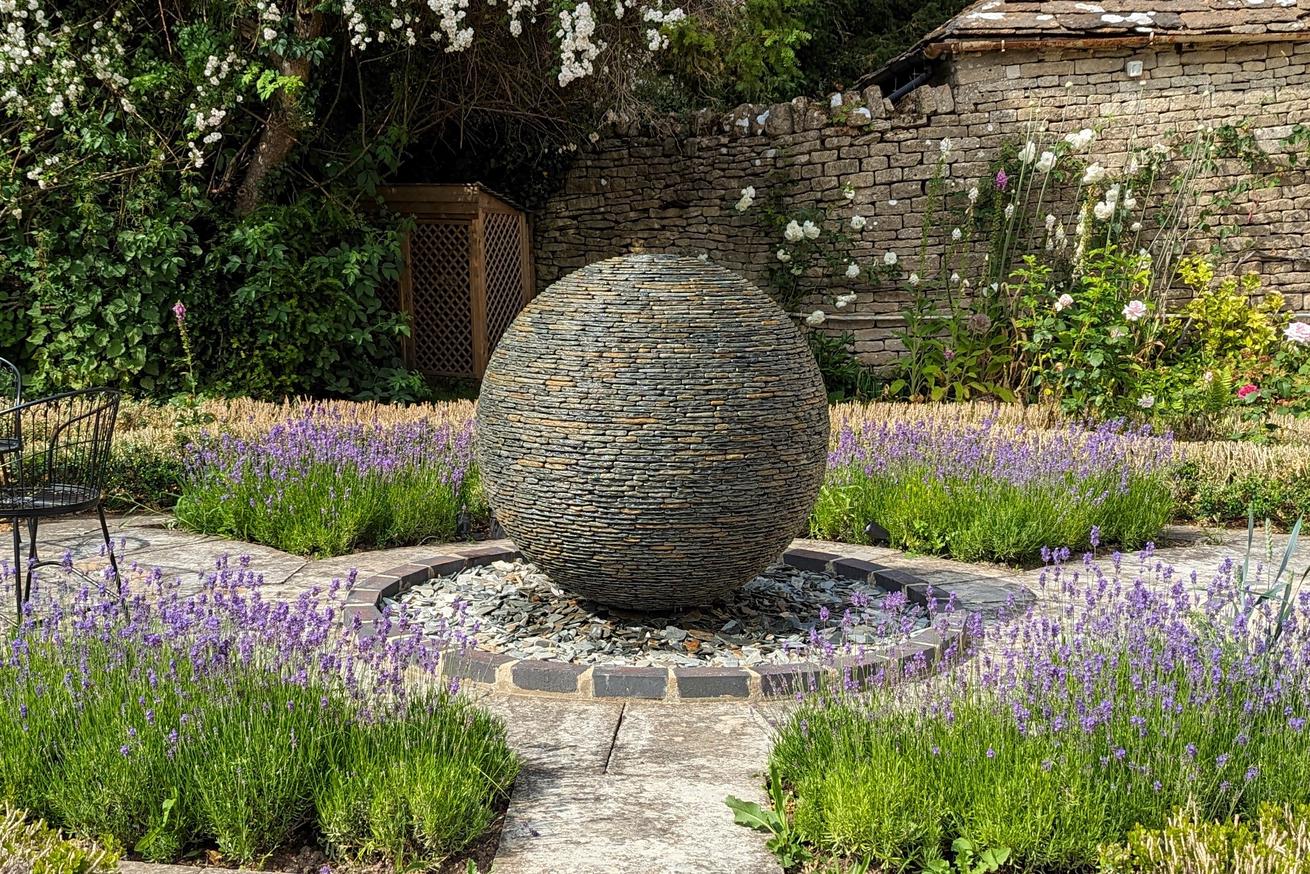
Unlike polished fountains, our spheres are made from hand-split Cornish slate. Each piece is split along the natural layers of the stone rather than being machine polished smooth.
This process leaves a textured surface with tiny ridges and edges. As water flows over the sphere, these small variations in the stone catch and break the water, spreading it across the surface rather than allowing it to slide straight off.
Instead of one single sheet of water, the flow becomes thousands of small movements as the water travels down the curve of the sphere.
This creates a much softer and more natural sound.
Designed through horizontal layers
The sound is not simply a happy accident of the material. It is deliberately created through the way the spheres are constructed.
Each sphere is built in horizontal layers of slate, with the pieces carefully shaped and placed around the curve of the form. These layers create countless small ledges where the water gently breaks as it moves downward.
As the water passes over each layer it slows, spreads and reforms again before continuing its journey. This repeated interaction with the horizontal layers produces the distinctive rippling sound that people often comment on.
Rather than falling from a single point, the water moves gradually over the entire surface of the sphere.
Thousands of small interactions
A typical slate sphere contains thousands of individual pieces of slate. Each one has its own natural shape and texture.
Some pieces create tiny ripples, others guide the water sideways, while some cause small cascades between the layers. Together, these subtle interactions combine to produce the overall sound of the feature.
It’s a complex effect created from very simple natural elements: stone, water and gravity.
Why smooth fountains sound different
Many mass-produced water features are made from polished stone, cast concrete or resin. These materials tend to have smooth surfaces.
When water flows across a smooth surface, it often moves as a single sheet before dropping off an edge. The sound therefore comes mainly from one place where the water falls.
This can create a sharper splash rather than the gentle, continuous sound people usually want in a garden.
By contrast, the textured surface and layered construction of slate spreads the movement of water across the entire sphere.
A sound that belongs in the garden
In many gardens the sound of water is just as important as the visual effect.
A well-designed water feature should add atmosphere without overwhelming the space. The aim is always a calm, natural sound that blends with planting, birds and the general quiet of the garden.
When it works well, people often hear the feature before they notice where it’s coming from.
And that is usually when they begin to wonder why it sounds different.
Find out more
If you would like to see how these slate spheres are made, or hear the sound of the water for yourself, you can explore the full collection of handcrafted slate water features on our website.
Or feel free to get in touch with Jeremy to discuss the sizes and designs that would work best in your garden.